Choose a vacuum cup in this order: match the cup profile to the workpiece surface and height variation, choose the material for temperature, oil, wear and marking requirements, size the sealing area from the required holding force, then confirm vacuum flow, mounting and performance on the real production cycle.
No single cup is best for every machine. A cup that seals well on a smooth metal panel may be unstable on a curved part, while a highly compliant bellows cup may add unnecessary movement on a flat, fast-moving workpiece.
Quick vacuum cup selection checklist
- Describe the pickup surface: flat, curved, textured, porous, oily, flexible or easily marked.
- Choose the profile: flat for stability, bellows for compliance, or an application-specific design for film and bags.
- Choose the material: compare temperature, oil exposure, abrasion, flexibility, marking and chemical contact.
- Calculate the required force: include workpiece mass, acceleration, load direction, cup quantity and a safety factor.
- Confirm the complete system: effective sealing diameter, fitting, installed height, tubing, valves, generator flow and release time.
- Run a production test: use representative good and worst-case parts at the actual speed and motion profile.

1. Match the cup profile to the workpiece
| Workpiece or process | Profile to evaluate first | Main checks |
|---|---|---|
| Smooth, flat, rigid surface | Flat cup | Sealing area, edge distance, acceleration and lateral stability |
| Curved part or variable pickup height | Single or multi-bellows cup | Bellows stroke, contraction, sway, installed height and release time |
| Narrow or elongated pickup area | Oval or application-specific profile | Available sealing footprint and alignment |
| Flexible film or bag opening | Thin-material or bag-opening cup | Wrinkling, leakage, flow, lip damage and repeatable separation |
| Rough or porous surface | Soft lip, foam or high-flow solution | Leakage rate, available flow, contamination and cycle time |
| Delicate surface or non-contact requirement | Application-specific handling tool | Permitted marks, gap, air consumption and fail-safe behavior |
A flat cup usually offers low internal volume and good lateral stability. Bellows add vertical and angular compliance but can increase movement and evacuation volume. Read the detailed flat versus bellows vacuum cup guide before choosing the number of bellows.
2. Select the material for the environment
| Material family | Common reason to evaluate it | Confirm before selection |
|---|---|---|
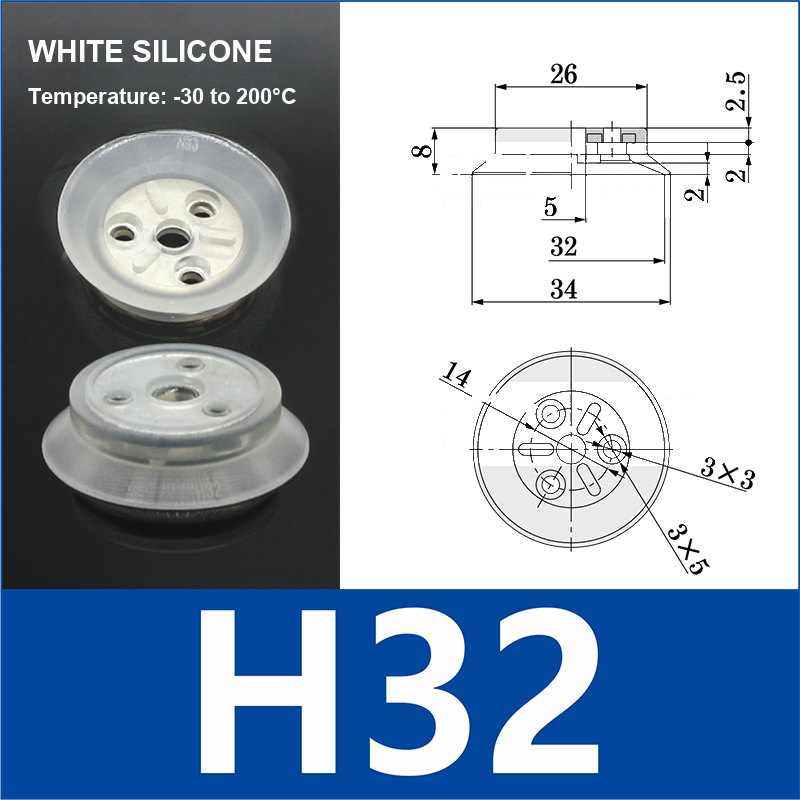
| Silicone | Compliant sealing and broad temperature capability | Exact compound rating, wear, marking and application compatibility |
| NBR | General industrial use, wear resistance and many oil-contact applications | Temperature range, ozone exposure, compound hardness and the actual fluid |
| Polyurethane | Abrasion resistance and demanding repeated-contact applications | Hardness, sealing on the real texture, hydrolysis and temperature |
| Foam or specialty compounds | Rough, porous, delicate or chemically demanding workpieces | Leakage, wear life, compatibility and replacement interval |
Material names alone do not define performance. Formulation and hardness matter, so use the selected model's datasheet and test the actual workpiece. The Silicone vs NBR guide explains the two most common starting options.
3. Size the cup from force, not outside diameter alone
For a sealed cup on a rigid, non-porous surface, the ideal normal holding force starts with:
Ftheoretical = Δp × A
Here, Δp is the pressure difference and A is the effective sealed area. Catalog outside diameter may be larger than the effective sealing diameter, and the real force can be reduced by leakage, texture, curvature, acceleration, uneven load sharing and lip deformation.
- Calculate the total force required from mass, gravity and worst-case acceleration.
- Apply a safety factor appropriate to the load direction, machine risk assessment and applicable requirements.
- Divide only by the number of cups that can reliably share the load.
- Round up to an available model that keeps the complete sealing lip inside a stable surface area.
Use the worked examples and cautions in the vacuum cup holding-force and diameter guide. Never use a simple theoretical calculation as the sole safeguard for personnel or suspended loads.
4. Confirm mounting, vacuum flow and release
- Mounting: verify the thread, fitting direction, installed height and available approach travel.
- Level compensation: use a spring plunger or joint when pickup height or approach angle varies, while checking added movement.
- Vacuum at the cup: measure during the cycle; generator rating alone does not prove the cup reaches the target vacuum.
- Leakage and flow: porous, textured and flexible parts may require more flow instead of a higher nominal vacuum.
- Tubing and valves: restrictions and long lines can slow pickup and release.
- Failure response: define how the machine detects a missed pick, leak or vacuum loss.
For a telescopic fitting option, review the VP-CLF vacuum buffer fittings and confirm the complete model, stroke and mating threads against the selected drawing.
5. Start from the application, then narrow the model
| Selection route | Useful starting point |
|---|---|
| Stable handling of smooth rigid components | PFG / PA flat vacuum cups |
| Flat pickup with a G1/4 female connection | PFYN flat vacuum cups: 60, 80 and 95 mm. Compare white silicone and black NBR options; verify the selected drawing, sealing surface and holding performance before use. |
| Curved parts or pickup-height variation | PJG double-bellows vacuum cups |
| Heavy-duty flat handling | H-series heavy-duty flat vacuum cups |
| Flexible packaging and bag opening | STP35 / STP60 bag-opening assemblies |
| Compact side-port pickup with silicone or NBR cups | PAK side-port vacuum cups, 5–50 mm |
| Side-port holder and adapter selection | ZPRS / ZPRL holders and ZPT adapters |
| Spring-loaded height compensation and mounting | M14 / M16 spring-loaded buffer mounts |
| Glass, mirror or solar-panel handling where contact marks matter | Non-marking vacuum cup fabric covers, 12–300 mm. Covers only; vacuum cups are not included. Match diameter and hole pattern, then test the complete system on the actual workpiece. |
| Paper feeding, sheet separation and bookbinding equipment | Bookbinding machine suction cups and nozzles. Match material, diameter, bore and machine interface to the exact replacement position. |
| Compare more profiles and sizes | Standard vacuum cup collection |
| Compare silicone options | Silicone vacuum cup collection |
For thin film and flexible packaging, begin with the bag-opening and packaging machine guide. These product links are starting points, not a substitute for checking the exact model, variant and datasheet.
6. Validate the selected cup on the machine
- Test representative clean parts and the worst expected surface condition.
- Run the actual approach, acceleration, deceleration and release sequence.
- Record vacuum build time, minimum vacuum during motion, slip, sway and release time.
- Check the workpiece for marks, deformation or damage.
- Inspect the cup for folding, abnormal wear and heat or chemical effects.
- Confirm the machine's response to a missed cup or vacuum loss.
Vacuum cup selection FAQ
What is the best vacuum cup for a flat surface?
A flat cup is usually the first profile to evaluate for a smooth, rigid, repeatable surface because it is compact and laterally stable. Final selection still depends on force, edge distance, material, acceleration and release time.
Should I choose silicone or NBR?
Start with silicone when compliant sealing or broader temperature capability is important, and evaluate NBR for general industrial wear and many oil-contact applications. Confirm the exact compound and operating environment before ordering.
Is a larger vacuum cup always safer?
No. A larger effective area can increase theoretical force, but an oversized lip may cross an edge, bridge curvature, cover a hole or deform thin material. Use the smallest model that meets the verified force and sealing requirements with the required safety margin.
How do I choose a cup for a porous surface?
Measure the real leakage and determine whether the system can supply enough flow at the cup. A soft lip, foam seal or application-specific high-flow solution may work better than simply increasing vacuum level.
What information is needed for a model recommendation?
Send a photo or drawing of the pickup surface, workpiece dimensions and weight, surface material and texture, temperature and contamination, motion and cycle time, available vacuum and flow, cup quantity, mounting thread and available installed height.
Need help narrowing the model? Submit the workpiece and machine details through the BOLTTE vacuum application RFQ. Recommendations, specifications, price and availability are confirmed after reviewing the exact application and selected variant.