A bag-opening station looks simple: one cup grips each side and the machine pulls the mouth apart. In production, the seal can change with every pouch because film thickness, wrinkles, seams, printing, static and package stiffness vary. Reliable selection starts with the bag and machine motion, then matches the cup profile, size, vacuum source and mounting.
Why bag opening is difficult
Flexible packaging does not behave like a rigid sheet. Thin film moves toward the cup, a seam creates a leak path, and excessive vacuum can wrinkle or pull the material into the opening. A cup that passes a static bench test may still release during acceleration. Treat the cup, vacuum generator, tubing, valve timing and pickup position as one system.
1. Document the bag
- Film material, thickness and number of layers
- Bag width, mouth geometry, gusset, zipper and seal locations
- Printed, coated, matte, glossy or textured surfaces
- Perforations, wrinkles and whether air can leak through the material
- Empty bag or filled package, plus the force required to separate the sides
2. Choose the pickup point and diameter
Use the largest cup that fits completely inside a stable, relatively flat area, but do not cover an edge, seam or zipper. A larger diameter can provide more theoretical holding force, yet it may also bridge wrinkles or deform thin film. Mark the proposed pickup point on a bag sample and test several pieces from normal production—not only a perfect sample.
3. Match the cup profile
A compliant lip follows small wrinkles and surface variation. A supported or bag-opening-specific profile helps prevent thin film from being drawn too deeply into the cup. Bellows can compensate for height and approach variation but may introduce more movement. The best profile is the one that maintains a seal through the complete opening stroke without damaging or marking the package.
4. Balance vacuum level and flow
Vacuum level creates pressure difference; flow compensates for leakage. A well-sealed pouch may need controlled vacuum to avoid deformation. A leaky film or pickup point may require greater flow and shorter tubing. Keep hoses as short and unrestricted as practical, check fittings for internal restrictions, and place the valve or vacuum generator close enough to achieve the required response time.
5. Check motion, timing and alignment
- Confirm both cups contact the bag at the same time and height.
- Allow enough dwell time for vacuum to build before the opening stroke.
- Use a vacuum switch or sensor to detect a missed pickup when the process requires it.
- Reduce initial acceleration if the bag releases only at production speed.
- Check that hoses do not pull on the cup or restrict the moving axis.
BOLTTE bag-opening series
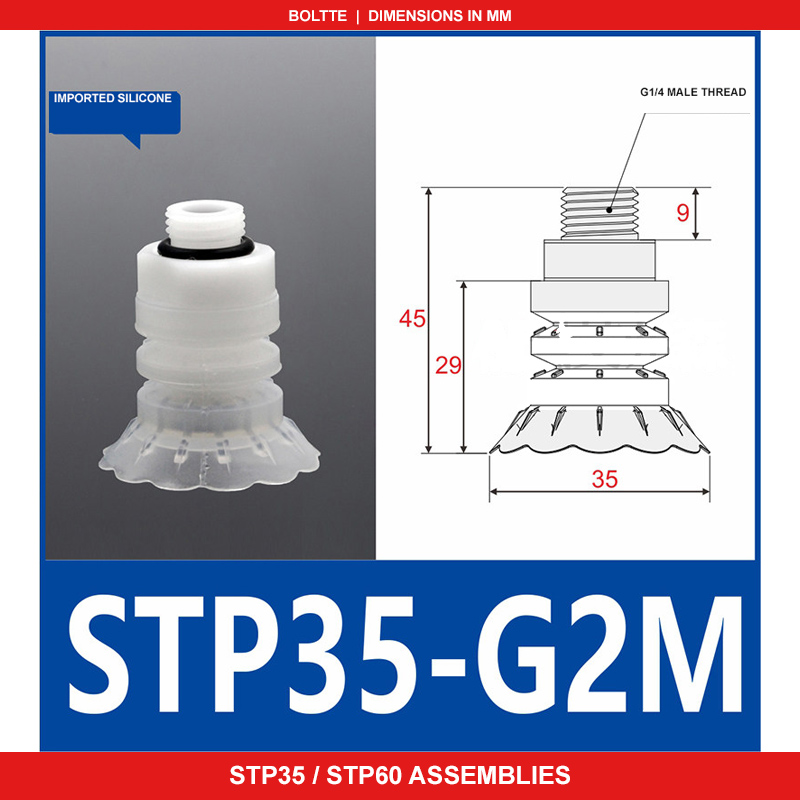
The Packaging / Bag Opening collection includes several starting points. STP35/STP60 options include complete assemblies and replacement components such as cup-only and silencer items. Confirm the exact model and what is included before ordering. VP, SGP, PAG, ZP3P and BGI cover different cup and fitting requirements; F18/F22/F26/F33 offers diameter-based replacement options.
For woven-bag opening, compare QLF68 and QLF90 silicone vacuum cups, 68 and 90 mm. Check the model-specific mounting drawing and test sealing on the actual bag material; these are application-specific options, not an automatic substitute for thin-film pouch cups.
Production test checklist
- Test multiple bags from different positions in the stack or roll.
- Run at normal temperature, humidity and production speed.
- Record vacuum build time and vacuum level at grip confirmation.
- Check both sides for wrinkles, marks, incomplete opening and early release.
- Inspect the cup lip after repeated cycles and define a preventive replacement interval.
What to include in an RFQ
Send bag photos or samples, film type and thickness, pickup-point dimensions, current cup and fitting measurements, machine cycle rate, vacuum source and the failure you are trying to solve. If a direct replacement is needed, include clear photos of the cup, thread and overall installed height. Ask BOLTTE for bag-opening application help.
For the complete decision path across profile, material, force, diameter, mounting and testing, start with the BOLTTE vacuum cup selection guide.
Replacement Lookup: Bag-Opening Cup, Assembly or Clamping Pad?
Start by identifying which item the machine needs. A bag-opening vacuum cup, a generator assembly and a bag-clamping pad are not the same order item.
- STP35/STP60 cups and assemblies: select the complete label. Cup-only, threaded, BM30-B assembly and separate silencer options have different purchasing scopes. See the STP35 vs STP60 buying guide.
- Mixed packaging-machine vacuum cups and bag-clamping pads: use the model/SKU table and exact variant photograph. F25 White/Blue Silicone options are labelled for bag opening; AFS-15-13-N and AFS-15-13-S are labelled bag-clamping pads. Similar application names do not establish interchangeability.
- For an unidentified replacement, record the installed part's contact face, side profile, dimensions, mounting and connection before choosing a new family. Prepare each full model and quantity separately using the replacement vacuum cup order checklist.
If a correctly identified cup still loses the bag, use the leak, weak-grip and slow-pickup troubleshooting guide before assuming a larger diameter will solve the problem. Validate any change on the actual bag and complete machine cycle.