Flat and bellows vacuum cups can have the same nominal diameter yet behave very differently on a machine. A flat cup is compact and stable; a bellows cup adds compliance and vertical stroke. The correct choice depends on surface shape, height variation, approach angle, acceleration and release-time requirements.
Quick comparison
| Selection factor | Flat cup | Bellows cup |
|---|---|---|
| Best starting surface | Smooth, flat or gently curved | Curved, uneven or height-variable |
| Vertical compensation | Low | Medium to high, depending on bellows count |
| Lateral stability | Usually higher | Lower because the bellows can flex |
| Evacuation and release | Usually faster because internal volume is smaller | Can be slower because internal volume and stroke are greater |
| Handling thin parts | Stable when the lip seals without local distortion | Useful for compliance, but excess vacuum or stroke can deform the part |
| Typical use | Sheet metal, glass, panels and rigid components | Curved products, cartons, molded parts and uneven pick layers |
When to choose a flat vacuum cup

A flat cup is normally the first candidate for a smooth, rigid workpiece with a repeatable pickup height. Its low internal volume can help vacuum build and release quickly, and the compact profile usually limits sideways movement during acceleration.
- Use it when the sealing area is flat enough for the complete lip to contact.
- Prefer it for short cycle times where fast evacuation and release matter.
- Use a supported or reinforced profile when lateral acceleration or shear load is high.
- Add a separate spring plunger or level compensator when the machine needs axial compliance without the lateral flexibility of multiple bellows.
A flat cup is less forgiving when the part height varies, the approach is angled or the pickup surface is strongly convex.
When to choose a bellows vacuum cup
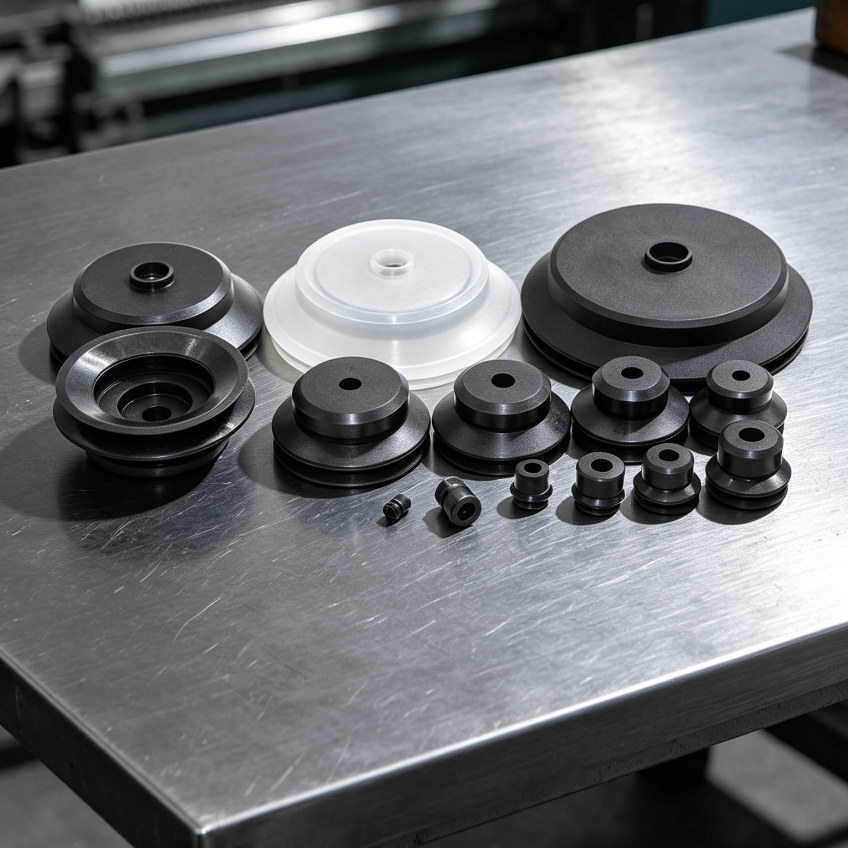
A bellows cup behaves like a small flexible spring. As vacuum is applied, the bellows can contract and lift the workpiece slightly. This helps the lip conform to curvature, allows limited height compensation and can soften the initial contact.
- Use one or more bellows when product height changes within the pickup array.
- Consider bellows for convex surfaces and parts approached at a slight angle.
- Use the minimum bellows count that provides the required stroke and conformity.
- Check that contraction does not pull, wrinkle or tilt a thin workpiece.
More bellows generally provide more stroke and angular compliance, but also increase internal volume, overall height and the possibility of pendulum movement. High accelerations may require a larger layout, stiffer profile or mechanical support.
Single bellows or multiple bellows?
A single-bellows profile is a practical middle ground when a flat cup cannot follow the surface but the machine still needs reasonable stability. Double or multi-bellows profiles are useful for deeper curvature and larger height differences. Choose by the actual compressed and extended dimensions rather than the word “bellows” alone.
| Profile | Typical advantage | Main check |
|---|---|---|
| Flat | Fast, compact, laterally stable | Requires repeatable surface contact |
| Single bellows | Moderate compliance with controlled height | Verify contraction and side movement |
| Double or multi-bellows | Greater stroke and conformity | Verify response time, installed height and stability |
Profile does not replace material selection
After choosing the geometry, select the compound for temperature, oil, abrasion, marking and compliance requirements. Silicone often offers broad temperature capability and a compliant lip. NBR is a common general-purpose choice and is often preferred around mineral oil. Exact performance depends on the formulation, so confirm the selected model's datasheet and test the real workpiece. See the Silicone vs NBR material guide for the material comparison.
A practical selection test
- Measure the flattest available pickup area and the maximum local curvature.
- Record part-to-part height variation and the robot's approach tolerance.
- Test the smallest compliant profile that seals throughout the motion.
- Run at production acceleration and observe sway, slip, vacuum loss and release time.
- Inspect the part for marks or deformation and the cup for abnormal folding or wear.
Information to send for model selection
Provide a photo or drawing of the pickup surface, workpiece weight, curvature, surface texture, height variation, cycle time, acceleration, vacuum level, available mounting height, thread and material environment. Browse BOLTTE standard vacuum cups or request application help when the correct profile is uncertain.