Silicone and NBR are two of the most common elastomers used in industrial vacuum suction cups. Both can provide a reliable seal, but they behave differently around heat, oil, wear and delicate workpieces. The correct choice depends on the complete application: surface, temperature, chemicals, cycle rate, vacuum level and expected service life.
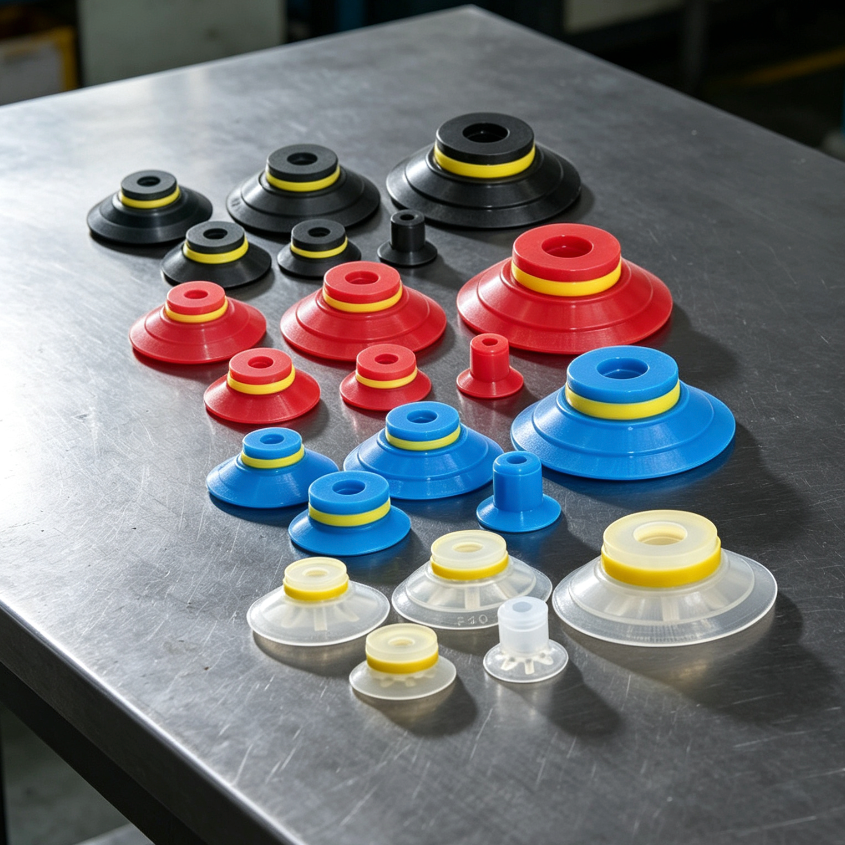
Quick comparison
| Selection factor | Silicone | NBR |
|---|---|---|
| Temperature | Usually the better starting point for high or low temperatures | Best for moderate industrial temperatures |
| Oil resistance | Limited for many oils and fuels | Commonly preferred around mineral oils and lubricants |
| Wear resistance | Soft and compliant; inspect wear in abrasive service | Often gives better abrasion and tear performance |
| Flexibility and sealing | Remains flexible across a broad range and can suit delicate surfaces | Strong general-purpose sealing on many industrial parts |
| Marking | Color and compound affect marking; test the actual workpiece | Black compounds may mark some surfaces; test when appearance is critical |
| Food contact | Only use a specifically certified food-contact compound | Only use a specifically certified compound where required |
Temperature is a range, not a single limit
Many industrial silicone compounds are specified across a broader temperature range than standard NBR compounds. Typical catalog ranges are often around -60 to 200 °C for silicone and around -30 to 100 or 120 °C for NBR, but those numbers are not universal. Compound formulation, exposure time, vacuum level, hot-surface contact, cleaning chemicals and mechanical load can lower the practical limit. Confirm the exact datasheet for the selected cup and test under the real cycle.
When silicone is the stronger candidate
- Hot or cold parts outside the normal range of a general-purpose NBR cup
- Applications that benefit from a soft, compliant sealing lip
- Food or medical handling only when the exact compound has the required certification
- Curved or delicate products where the correct silicone profile reduces local pressure
Explore BOLTTE silicone vacuum cups, including flat, bellows, spherical, mini and heavy-duty profiles.
For round white silicone cups used on industrial robots, compare the DP-SA series: DP-32SA, DP-45SA, DP-53SA and two DP-55SA profiles. The product page includes model-specific diameter and overall-height values. Match the complete mounting drawing; the general material guidance here does not certify these models for a particular temperature or food-contact application.
When NBR is the stronger candidate
- General industrial handling at moderate temperatures
- Workpieces with oil or lubricant where the selected NBR grade is compatible
- High-cycle applications where abrasion and tear resistance are important
- Cost-sensitive replacement programs with stable operating conditions
Profile matters as much as material
A material change cannot correct the wrong cup geometry. Use flat cups for smooth, flat parts and fast release. Use one or more bellows when the cup needs to follow curvature, compensate for height or approach at a slight angle. For very flexible film or bags, choose a profile designed to limit wrinkles and leakage. For porous parts, check whether the vacuum source can supply enough flow.
A five-step selection method
- Record the workpiece material, texture, curvature and whether oil, dust or moisture is present.
- Measure the actual surface temperature at pickup and the duration of contact.
- Calculate load per cup with a safety factor for acceleration and emergency stops.
- Select the cup profile, diameter, thread, port direction and any spring compensation.
- Run a production-speed trial and inspect sealing, release time, marking and wear.
For a complete spring-loaded side-port assembly, compare PJYS models in 60, 70 and 80 mm with silicone or NBR cup options.
Information to send for model selection
Provide a part photo or drawing, weight and dimensions, surface condition, temperature, contact time, cycle rate, vacuum level, number of cups and mounting interface. If chemical exposure or compliance is important, include the chemical name and required standard. Request application help from BOLTTE before a volume order.
For the complete decision path across profile, material, force, diameter, mounting and testing, start with the BOLTTE vacuum cup selection guide.