Porous and textured workpieces are different from smooth glass, metal or molded plastic. Cardboard, paperboard, MDF, unfinished wood, foam and rough surfaces allow air to leak through or around the contact area. A vacuum system may still pick the part reliably, but selection must consider vacuum flow, cup profile, contact area and handling motion—not only cup diameter.
This guide explains how to build a practical starting point for porous-material handling. It is not a certified load calculation. Test the real workpiece, including normal variation in dust, moisture, surface finish and flatness, before releasing the application for production.
Why porous materials need a different selection method
A conventional holding-force estimate assumes that enough vacuum can be maintained across the usable cup area. With a porous substrate, air leakage may prevent the circuit from reaching the expected vacuum level. Increasing cup diameter alone may not solve the problem: a larger cup can create more potential contact area, but it may also cover more leaking surface.
Start by observing the actual vacuum level and pickup time at the cup under operating conditions. If the cup seals well on a test plate but performs poorly on the production part, leakage through the workpiece or texture is likely part of the problem. The holding-force and diameter guide explains why real vacuum level and safety factor must be included in the estimate.
Classify the workpiece before choosing the cup
Corrugated board, carton blanks and paperboard
Paper-based materials can leak through the sheet, particularly near cut edges, perforations, folds and dusty areas. They may also flex during acceleration. Use a test sample that includes the thinnest board, largest cutout, highest dust level and fastest intended motion. A stable pickup may require more flow capacity, more than one cup, a cup profile that follows minor unevenness, or a slower initial lift.
Wood, MDF and unfinished composite panels
Surface texture, grain, edge porosity and dust can vary significantly. Position cups away from damaged edges when possible. Avoid assuming that a test on a sealed board represents an unfinished panel. Check whether a flat cup maintains contact or whether a more compliant profile improves the seal without causing unacceptable marking.
Foam, fabric-backed materials and soft textured parts
Soft materials can deform into the cup, changing the effective contact area and increasing the chance of a slow release. Choose a profile that supports the workpiece appropriately, then test both pickup and release. A cup that grips strongly can still create a problem if the part is damaged, marked or delayed during release.
Textured plastics and molded surfaces
Textured plastic may not be porous, but micro-texture, ribs, labels and curvature can create leakage paths. Confirm cup placement on the real contact zone, not an adjacent smooth area. If the surface is curved, compare a flat profile with a bellows or compliant option. The flat vs bellows guide explains the basic profile trade-offs.

Match vacuum flow to leakage, not only vacuum level
For a leaking workpiece, a vacuum source with adequate flow can be more important than chasing a very high static vacuum value. Restriction in the hose, fitting, filter or generator can slow evacuation and make an otherwise suitable cup appear undersized. Measure pickup time at the intended hose length and routing. Do not evaluate a porous-material cup only with a short bench connection.
- Check the vacuum level at the cup while it is touching the real part.
- Measure time from contact to a stable pickup condition.
- Compare the most porous and least porous material samples.
- Inspect filters frequently when fibers, wood dust or foam particles are present.
- Test acceleration, orientation changes and release—not only a stationary vertical lift.
Choose profile, material and mounting for the contact zone
A flat cup can work well on sufficiently smooth, rigid areas. A bellows or more compliant profile can help follow height variation or curved regions, but it may reduce lateral stability. Material selection affects flexibility, wear, temperature behavior and potential marking. Select based on the actual environment; do not assume that one compound is suitable for all porous or textured workpieces.
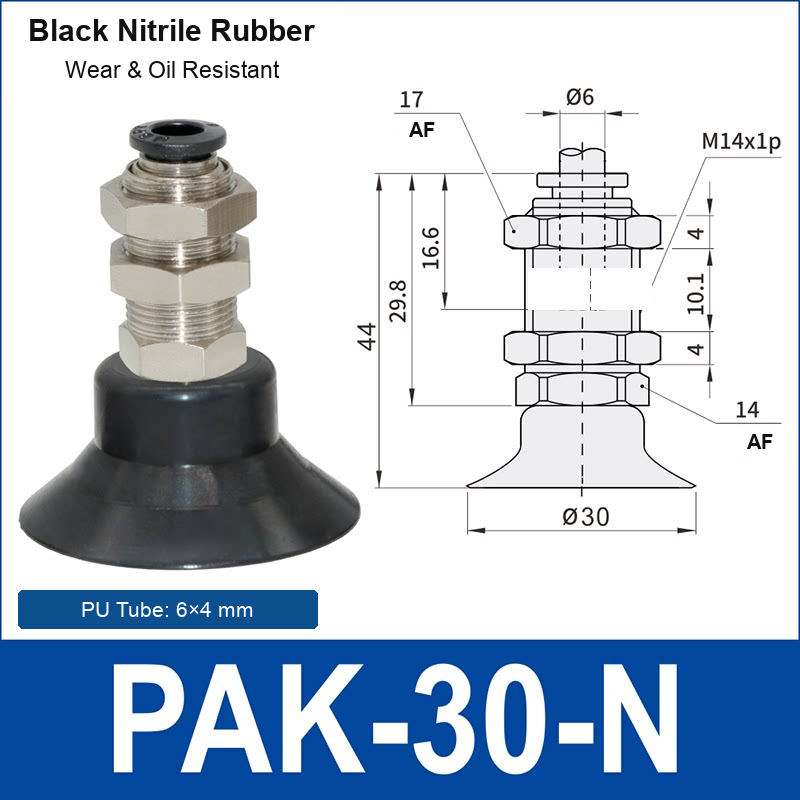
For compact applications with side-port routing, review the PAK side-port vacuum cup range. For foam and irregular surfaces, the foam vacuum cup range can provide useful geometry references. Confirm dimensions, material and compatibility for the exact selected model.
Compare the full foam vacuum gripper range for rough, porous and slightly uneven surfaces.
Use a production-style test plan
Test several workpieces rather than one ideal sample. Include different material lots, thicknesses, moisture levels, print coverage, surface textures and edge conditions where relevant. Start at a conservative acceleration and increase toward the intended cycle rate. Record the cup model, source vacuum, hose size, pickup time, part weight, orientation and any missed picks.
When a part is especially porous, do not claim a safety factor from a catalog value alone. Use measured performance with appropriate machine safeguards and engineering review. Multiple smaller cups, a different contact zone, a redesigned end effector or a different vacuum source can be better than forcing one oversized cup to solve every condition.
What to include in a quote request
For help with cardboard, wood, foam or textured surfaces, send a photo of the contact area, material type, dimensions, part weight, available vacuum source, hose size, desired cycle time, lift direction and any temperature or contamination conditions. Include a short video if the failure occurs only during motion. Request a Quote with those details for a focused recommendation.
This article provides general selection guidance only. It does not certify suitability for lifting safety, food contact, medical use or any regulated application.