The Seals, Bellows & Buffers category contains components with different functions. A dust boot covers moving parts, a seal controls a fluid interface, and a buffer or absorber addresses contact or motion energy. Putting them in one catalogue family helps navigation; it does not make their functions interchangeable.
Start selection with the duty, then the complete geometry and operating conditions. This guide uses BOLTTE rubber bellows and EPDM seal listings as examples. It deliberately avoids universal pressure, temperature, chemical or lifetime ratings, because those require evidence for the exact material compound and component.
1. Identify what the component must actually do
State whether you need dust protection, a replacement sealing profile, an end stop or energy absorption. Describe the moving parts and the consequence of failure. A flexible cover that keeps debris away is not automatically a pressure-containing seal, and a rubber stop is not automatically a rated shock absorber.
For replacement work, identify the original machine or valve model and the existing part's position. Record how it is attached and which surface makes contact. If the old component has deformed or worn, its current dimensions may not reproduce the original geometry. Obtain the approved drawing or a reliable reference part wherever possible.
2. Read every bellows dimension and mounting feature
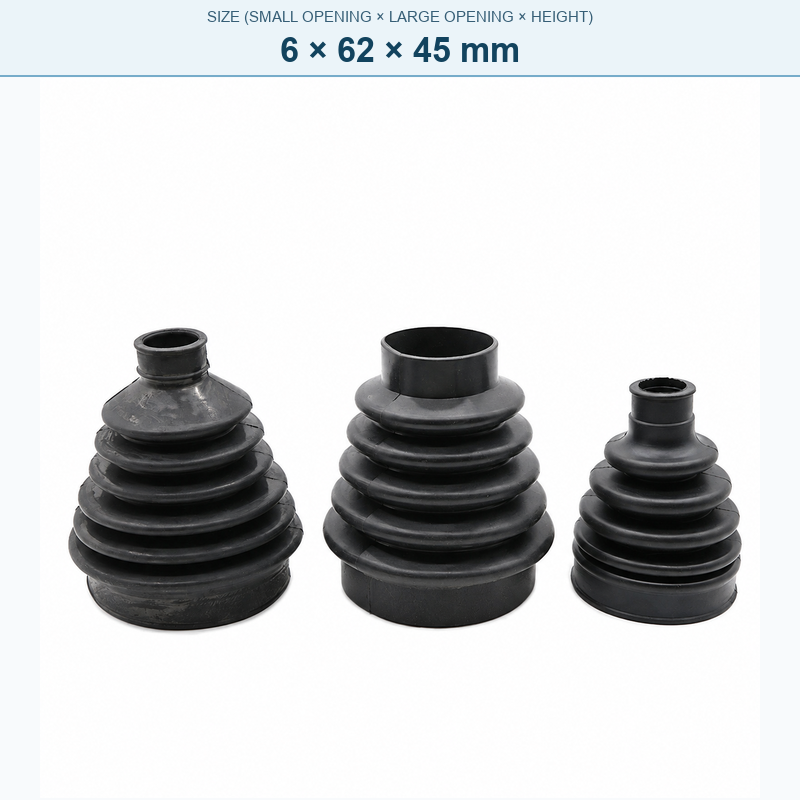
The BOLTTE pagoda-style bellows listing labels selector dimensions as small opening × large opening × overall height in millimetres. These dimensions must be read together. The title's bore range is not enough to identify the correct fixed-size model.
Compare the matching drawing with both attachment points and the available space. Confirm whether the model includes a flange or a specifically identified material option. Some source material uses an explicitly labelled reference image where no individual photograph was supplied. Do not treat that image as proof that every option has identical openings, geometry or mounting details.
3. Check motion instead of selecting by free height alone
Describe the minimum and maximum separation of the mounting points and any rotation or lateral movement. Ask for the permissible compressed and extended conditions of the selected boot. Free height alone does not establish usable stroke, fatigue life or clearance between folds.
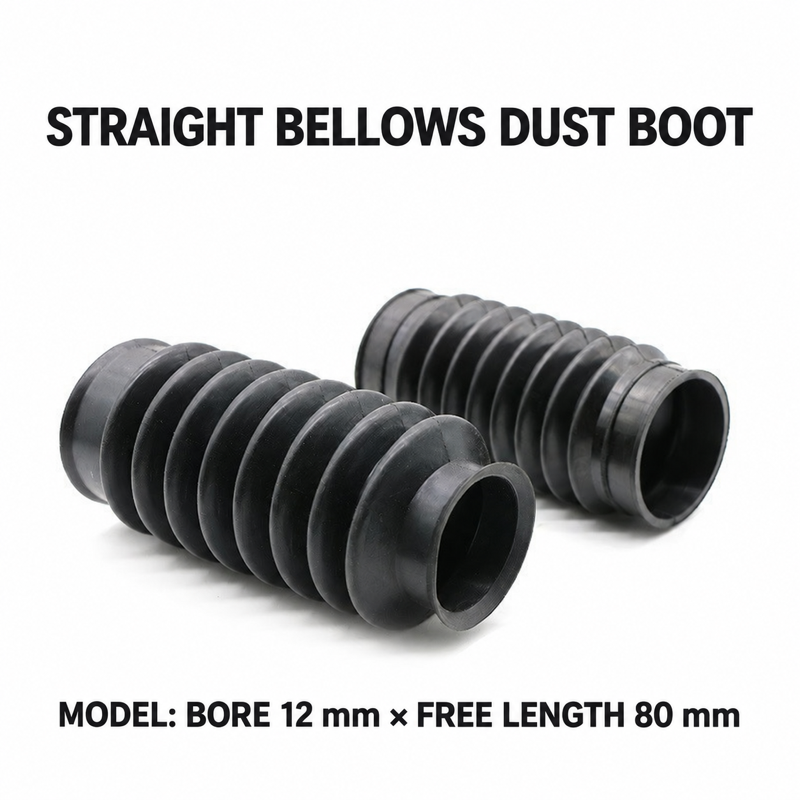
Review neighbouring parts through the entire movement. A cover should not be forced against sharp features or installed in an arrangement that traps it between moving surfaces. The straight bellows range is a separate family; compare its exact model drawing rather than assuming it is a direct replacement for the pagoda profile.
4. Specify material exposure and evidence needed
Provide the actual fluids or chemicals, their concentration, operating and cleaning temperatures, pressure where applicable and exposure duration. Include sunlight, dust, abrasion and cleaning procedures if relevant. A broad word such as rubber does not identify a compound, and a material name alone is not a guarantee of compatibility.
Parker's O-ring handbook is a general reference for compound selection and compatibility review. Its data should not be transferred directly to an unidentified BOLTTE material or to a different seal geometry. Use the supplier's specific compound information and validate suitability under the real service conditions.
5. Match the complete seal profile, not one measurement
For a valve seal, inspect the tip, raised rings, flange, shoulders and mating recess, together with all specified dimensions. The 17.5 × 27 mm EPDM sampling-valve seal and 17 mm custom EPDM seal are separate listings. They must not be treated as interchangeable because both are black EPDM.
The 17 mm product image also marks Ø6.25 mm and Ø12.5 mm features. Match the whole illustrated profile and confirm the valve model before ordering. The term aseptic in the product description does not by itself establish a material certification, cleaning validation or approval for a regulated application. Request the specific documents required by your process.
6. Inspect and install through the approved procedure
Before maintenance, isolate the machine or process, release stored energy and follow its cleaning and safety procedure. Inspect the mating surfaces and supplied component for damage or contamination. Confirm the approved orientation, mounting method and any permitted assembly aid rather than applying a general lubricant to an unknown material.
After installation, perform the application-specific inspection or validation approved by the responsible engineer. A pressure seal and a dust boot require different acceptance checks. If leakage, rubbing, distortion or unexpected motion occurs, investigate before returning the machine to service. Do not attempt to compensate for an incorrect profile by forcing the assembly or omitting required retaining parts.
7. Record the exact replacement specification
An enquiry should include the function, machine or valve reference, full dimensional drawing, mounting details, movement range, medium and operating conditions. State required material documents and the number of components. Clear photographs help explain the arrangement but should not replace dimensions for critical sealing or attachment features.
Email BOLTTE the profile and operating requirements. Keep the confirmed model and drawing revision in the maintenance record. For components that do not match a standard listing, obtain a written custom quotation and approval of the complete specification before production.
Common ordering question
Is a nearly matching profile acceptable for a replacement?
Do not approve it from appearance alone. Document the difference and ask the responsible designer or maintenance engineer to review the mating geometry and duty. A similar overall height does not establish the same flange engagement, sealing location or movement clearance. Where no approved drawing exists, arrange a controlled identification or measurement process before ordering. Label the accepted reference clearly so future replacements use the same confirmed specification rather than a succession of visually similar parts with undocumented dimensional differences.