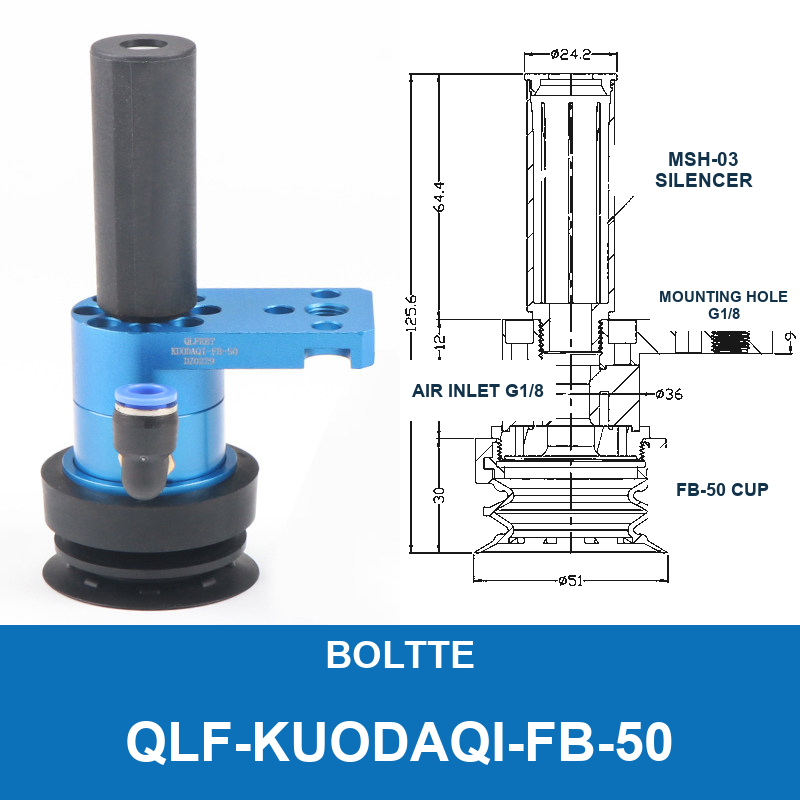
The BOLTTE SLB-50 is a 50 mm thin-lip vacuum cup assembly for buyers who need a defined cup size, an integrated compressed-air vacuum source and a replaceable sealing element. The same product page also lists FB-50 replacement cups, so a maintenance order can use the same model family instead of mixing an unverified cup with an existing holder.
What the SLB-50 product family includes
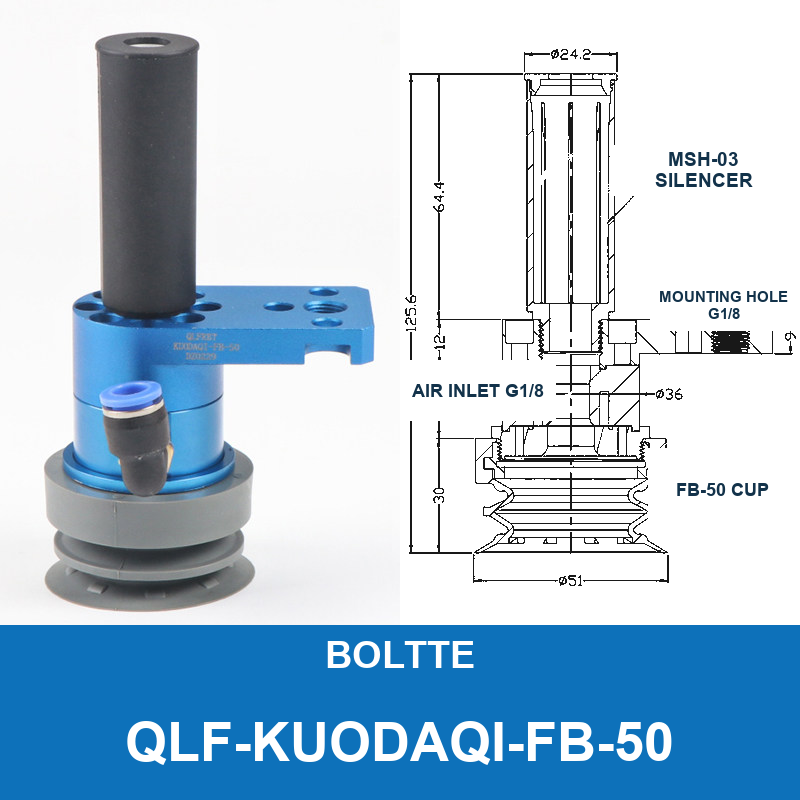
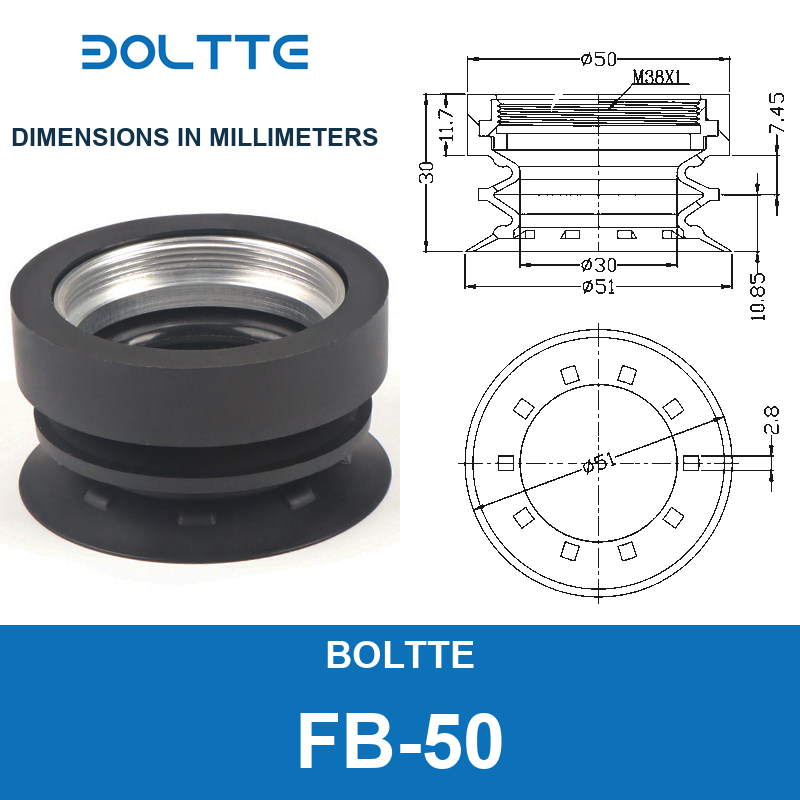
There are four purchasable variants on the current product page. The complete SLB-50 / QLF-KUODAQI-FB-50 assembly is offered with a black antistatic-rubber cup or a gray silicone cup. The FB-50 replacement cup is offered separately in black antistatic rubber or gray silicone. Confirm the exact variant before adding it to the cart: a replacement cup is not the same item as a complete air-powered assembly.
The listed assembly uses a 50 mm thin-lip profile. The product information also identifies a G1/8 air inlet, an 8 mm push-in fitting and an external silencer in the technical images. Use these as interface checks, not as a substitute for checking the dimensions and air circuit on your machine.
When a thin-lip cup is a useful starting point
A thin lip can be a practical starting point when the pickup area is reasonably defined but the workpiece is not perfectly flat. The profile needs enough sealing contact to hold vacuum while allowing the cup to settle against a flat, slightly curved or irregular surface. This does not mean every irregular surface will seal: texture, holes, contamination, porosity and sharp edges can still create leakage.
Use the SLB-50 as a candidate for automation handling, PCB handling, sheet handling or other applications where the 50 mm contact diameter fits the available pickup zone. Check the actual workpiece rather than choosing only from the nominal diameter.
Choose black antistatic rubber or gray silicone
The current variants identify black as antistatic rubber and gray as silicone. Material selection should follow the workpiece, environment and handling risk. Antistatic rubber may be preferred where static control is part of the machine requirement; silicone may be preferred when the specified surface-contact behavior or temperature range makes it the better candidate. The product page does not establish a universal temperature rating, chemical-resistance rating or certification for every application, so validate those conditions with your own process.
For replacement orders, match the material and color to the cup already installed. A different material can change friction, sealing behavior and release timing even when the outside diameter is the same.
Check the air connection before ordering
On complete assembly models, verify that your pneumatic layout can accept the listed G1/8 air inlet and 8 mm push-in connection. Confirm the fitting orientation, hose route, available clearance and the silencer location. The air-powered design still depends on the upstream air supply, valve timing, tubing volume and exhaust path. A compatible fitting alone does not guarantee the required pickup response.
Before installation, record the supply pressure and the machine's normal cycle time. Then inspect all seals and tubing for cuts, loose ends or restrictions. Keep the vacuum path short and protected from chips, dust and liquid where the process allows.
Installation and first-cycle checklist
- Confirm the selected item is the complete SLB-50 assembly or the FB-50 replacement cup you actually need.
- Check that the cup lip is clean, undamaged and seated squarely on its mounting surface.
- Connect the air line without twisting or side-loading the fitting.
- Position the cup so the full sealing lip can contact the intended pickup zone.
- Run a low-speed dry cycle and observe approach, contact, pickup and release.
- Check that the workpiece does not slide, flex excessively or touch nearby tooling.
Do not begin with maximum acceleration or the heaviest payload. Establish a repeatable baseline first, then increase speed and load one variable at a time.
Validate holding performance on the real workpiece
A static hand test is useful for finding an obvious leak, but it is not a production qualification. Test the actual surface, coating, temperature, orientation and motion used in the line. Record pickup success, evacuation time, release time and any dropped or shifted parts. Repeat the test after a warm-up period and after normal cleaning so the result reflects the process rather than a new, perfectly clean cup.
For horizontal or inverted handling, include the effects of acceleration and braking. Use a conservative safety margin and follow your machine's guarding and risk-assessment procedures. Never rely on vacuum alone to protect people from a falling load.
Replacement planning for FB-50 cups
Order the FB-50 replacement variant when the cup lip is worn, permanently deformed, cracked, contaminated beyond cleaning or no longer reaches the established pickup result. Keep a small, labeled spare stock by material and color. During a change, photograph the old orientation, clean the mating surface and repeat the same leak and cycle checks used during commissioning.
If a replacement cup does not restore performance, inspect the holder, air line, valve, silencer and workpiece condition before assuming the new cup is defective. A leak elsewhere in the circuit can look like a cup problem.
How to order the right configuration
Open the SLB-50 and FB-50 product page, select the model and material, enter the quantity and review the displayed price and delivery choices before checkout. If you need a different interface or a non-standard configuration, use the custom vacuum request form and include the workpiece, pickup zone, motion, air supply, quantity and required material.
For broader sizing context, compare the vacuum cup selection guide before you commit to a diameter. A documented application check is usually faster than replacing a cup after a production trial.
Safe boundary for production use
The SLB-50 should be released to production only after your team verifies fit, sealing, air supply, payload, acceleration, temperature, contamination and guarding on the actual machine. The model name and nominal diameter are selection clues, not a guaranteed load rating for every surface or motion. Stop the test if the workpiece shifts, the cup lip rolls, the air connection leaks or the machine enters an unsafe state.